
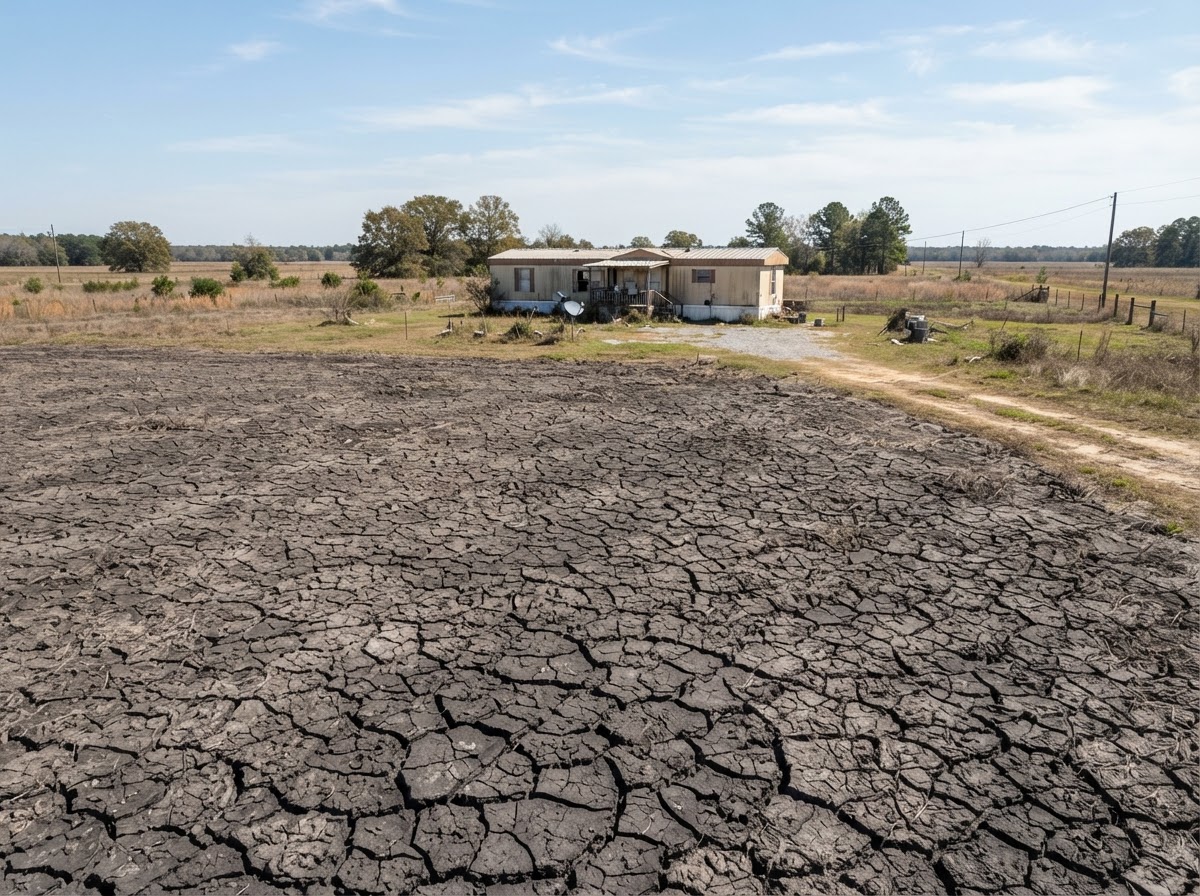
Leveling Mobile Homes on Black Belt Clay Soil Near Montgomery
Some Alabama soils — including parts of the Black Belt that reach toward Montgomery — can change behavior with moisture, and that can influence how a manufactured home's supports perform over time. But not every Montgomery-area property sits on the same soil, and soil behavior is not something a regional name can confirm.
This page explains how soil, moisture, and drainage can relate to manufactured-home foundation concerns, why leveling is not a permanent fix for soil-related movement, and when a site-specific or professional evaluation may be appropriate. It does not claim that every local property shares identical conditions, and it does not publish soil-bearing values, pier dimensions, or foundation designs.
Manufactured Home Foundation Concerns in Alabama's Black Belt
The Black Belt is a region, not a uniform soil type. Within it, soil composition, drainage, and moisture behavior vary by parcel, by elevation, and by how the lot was graded. What matters for a manufactured home is the actual ground beneath its supports — not a regional label. The considerations below describe how soil and moisture can interact with a foundation, without asserting that any particular property shares them.
Soil Variability
Wet and Dry Conditions
Drainage
Possible Volume Changes
Support Settlement
Existing Foundation Design
No property is diagnosed by its region
A property in or near the Black Belt is not assumed to have expansive clay, and a property elsewhere is not assumed to be free of soil concerns. The actual soil, drainage, and foundation on the actual lot are what an assessment addresses.
How Soil Relates to a Manufactured Home's Support System
A manufactured home rests on a support system that transfers the home's load to the ground. When that ground changes — through moisture, drainage, or settlement — the supports above can shift, and the home can go out of level. The relationship among the home configuration, the supports, the installation documentation, the site conditions, and qualified evaluation is what an assessment weighs. None of it is resolved by a single label or a single response.
Home Configuration
Support System
Installation Documentation
Site Conditions
Qualified Evaluation
No Universal Assumptions
Distinguishing Soil Movement From Other Causes Near Montgomery
Uneven floors and binding doors can come from soil movement — and from floor framing, drainage, pier deterioration, subfloor damage, and ordinary finish changes. Assuming soil is the cause because a home sits in a certain region is exactly the mistake an assessment is meant to avoid. The distinctions below frame what an assessment sorts through.
Visible Home Movement
What the homeowner notices — a slope, a sticky door, a gap — is the starting point, not the conclusion. Movement is a reason to look closer.
Soil-Related Hypotheses
Where soil may be contributing, that is a hypothesis to confirm against the actual lot, not an assumption to act on. Regional labels do not confirm it.
Drainage Problems
Drainage can produce the same symptoms as soil movement and can intensify soil movement where it exists. It is evaluated alongside, not separately.
Pier or Footing Deterioration
A deteriorated support can mimic settlement. Support condition is checked whether or not soil is also a factor.
Floor-System Defects
Framing and subfloor issues can create unevenness independent of the supports beneath. Not every slope comes from the ground.
Actual Geotechnical Evaluation
Where soil is genuinely the concern, a geotechnical evaluation is the appropriate input — performed by the qualified professional, not substituted by a contractor's observation.
No universal soil-bearing values, pier dimensions, or foundation designs are published here. Structural and geotechnical requirements are determined by qualified professionals for the specific property and home — not assumed from a regional soil label.
Black Belt Clay Soil & Mobile Home Leveling Questions
Common questions from homeowners in and near Alabama's Black Belt about soil, drainage, and manufactured-home support.
Related Foundation & Drainage Services
- Mobile Home Foundation RepairWhen findings point beyond leveling
- Mobile Home Re-LevelingSupport-alignment correction
- Mobile Home Pier ReplacementDeteriorated support components
- Mobile Home Crawl Space DrainageWater management beneath the home
- Re-Leveling After Heavy RainRelated moisture and support topic
- Contact & Assessment InquiryDescribe the property and concerns
Discuss Soil, Drainage, or Foundation Concerns for Your Home
If you are in or near Alabama's Black Belt and have noticed uneven floors, drainage issues, or support concerns in a manufactured home, describing the property, the site, and what you have observed helps frame an assessment. No assumption is made about your soil — the actual lot is what gets evaluated.
Your inquiry will be reviewed and you will be contacted about appropriate next steps. Where soil or drainage is a factor, that is identified for your property — not assumed from a regional name, and not resolved by leveling alone.