
Mobile Home Leveling vs Foundation Replacement: Which Is Needed?
A clear comparison of manufactured-home re-leveling and foundation replacement, the warning signs that point to each, and how a professional assessment determines the appropriate repair scope for homes in Montgomery and Central Alabama.
What is the difference between mobile home leveling and foundation replacement?
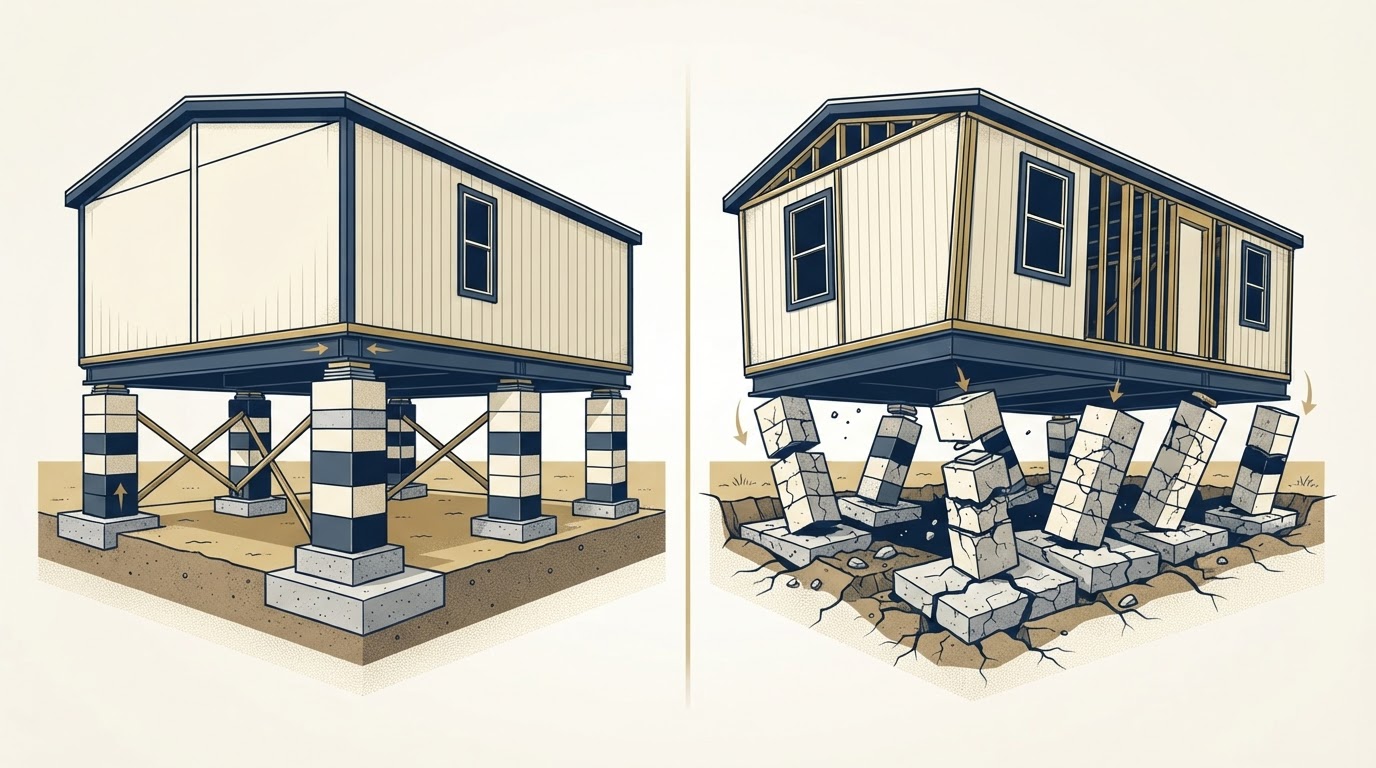
Leveling concerns correcting or adjusting the home's supported position, typically by adjusting existing piers and shims. Foundation replacement involves replacing support components or systems that are no longer suitable for their intended structural function, such as failed footings, deteriorated piers, or an inadequate foundation design. The two are not interchangeable; leveling cannot restore a failed support, and replacement is not needed for every home that has settled. A professional assessment determines which response, or combination, is appropriate for a given property.
1. Understanding the Difference
Leveling and foundation replacement address different aspects of a manufactured home's support system. Understanding the distinction helps homeowners interpret assessment findings and evaluate repair recommendations.
Leveling corrects the home's supported position. When a home has settled unevenly, a qualified professional can adjust the existing piers, shims, or supports to bring the home back toward a level position. Leveling assumes the existing supports are fundamentally sound and capable of carrying the load once repositioned.
Foundation replacement, by contrast, replaces support components or systems that are no longer suitable for their intended structural function. This may involve replacing deteriorated piers, reconstructing failed footings, installing a different foundation system, or addressing an inadequate original design. Replacement is appropriate when the existing supports cannot be restored by adjustment alone.
In practice, actual repairs can involve combinations of leveling, support replacement, drainage correction, and engineered foundation work. A professional assessment identifies which elements are needed for a specific property.
2. Situations Where Re-Leveling May Be Considered
Re-leveling may be appropriate when the home's supports are fundamentally sound but have shifted or settled over time. Several conditions can point toward leveling as a potential response, though each requires professional evaluation to confirm.
None of these conditions automatically means leveling is the correct or sufficient response. A professional assessment determines whether the supports can be adjusted or whether more extensive work is required.
- Settlement that has shifted the home from its original level position
- Uneven support distribution that has developed over time
- Previous installation conditions that allowed minor movement
- Localized movement affecting one area more than others
- Misalignment between sections of a multi-section home
- Support adjustment needs following seasonal ground changes
3. Signs That More Extensive Foundation Work May Be Needed
Certain warning signs suggest that the issue may extend beyond simple leveling and require more extensive foundation repair or replacement. These signs warrant a thorough professional assessment, and in some cases, engineering review.
The presence of one sign does not automatically require replacement, but multiple signs, or signs that recur after leveling, may indicate that the existing support system cannot be restored by adjustment alone.
- Deteriorated support components, such as crumbling or spalling concrete blocks
- Failed or displaced footings that have sunk, cracked, or shifted
- Damaged piers that are tilted, broken, or no longer plumb
- Structural framing concerns, including damaged or rotted floor joists
- Recurring movement after previous leveling work
- Significant moisture-related deterioration of supports or subfloor
- Site instability, including ongoing soil movement or erosion beneath the home
4. Comparing the Two Approaches
The comparison below summarizes the key differences between re-leveling and foundation repair or replacement at a homeowner level. Specific project details always require a professional assessment.
Questions Before Approving Foundation Work
- 1What caused the visible problem?Understanding the cause, whether settlement, drainage, deterioration, or site conditions, determines whether leveling or replacement is appropriate.
- 2Which supports are affected?Identify whether the concern is localized to specific piers or affects the entire support system.
- 3Is drainage contributing?Determine whether water or soil moisture is causing or worsening the condition, as drainage correction may be needed alongside structural work.
- 4Can damaged components be repaired?Clarify whether existing supports can be restored or whether they must be replaced.
- 5Is replacement necessary?Confirm whether the support system has failed beyond what adjustment or repair can address.
- 6Does the scope require engineering?Determine whether an engineered design or licensed engineer's review is required for the proposed work.
- 7Are permits or inspections applicable?Verify whether local permits, AMHC installation oversight, or inspections apply to the scope of work.
- 8What work is excluded from the estimate?Clarify what the estimate does and does not include, such as drainage, skirting, or underbelly work.
- 9What documentation will be provided?Confirm what written documentation, permits, and inspection records will be supplied upon completion.
- 10How will the completed work be evaluated?Establish how the finished work will be verified, whether by inspection, engineering re-evaluation, or both.
Verify current rules directly with the responsible federal, state, and local agencies:
- HUD Model Manufactured Home Installation Standards (24 CFR Part 3285)
Federal installation standards addressing foundation support, blocking, and leveling requirements for manufactured homes.
- Alabama Manufactured Housing Commission (AMHC)
State agency administering installation and foundation standards under Chapters 535-X-12 and 535-X-13.
- HUD Permanent Foundations Guide for Manufactured Housing (HUD-7548)
Foundation standard referenced for permanent foundation design and financing-related certification.
Regulatory Notice: This guide provides general educational information. Requirements can change and may vary by property location and project scope. Confirm current rules with the applicable government agency and qualified professionals before beginning work. Last verified: November 2026. Research verified November 2026.
Frequently Asked Questions
Related Alabama Foundation & Setup Services
Explore related services and educational guides for manufactured-home foundation care across Montgomery and Central Alabama:
Unsure Whether Your Home Needs Leveling or Foundation Replacement?
Discuss Your Project to describe observed symptoms and determine whether a professional assessment of your home's support system is the appropriate next step.
Inquiries are coordinated for residential and commercial manufactured homes across Montgomery, Autauga, and Elmore counties.