
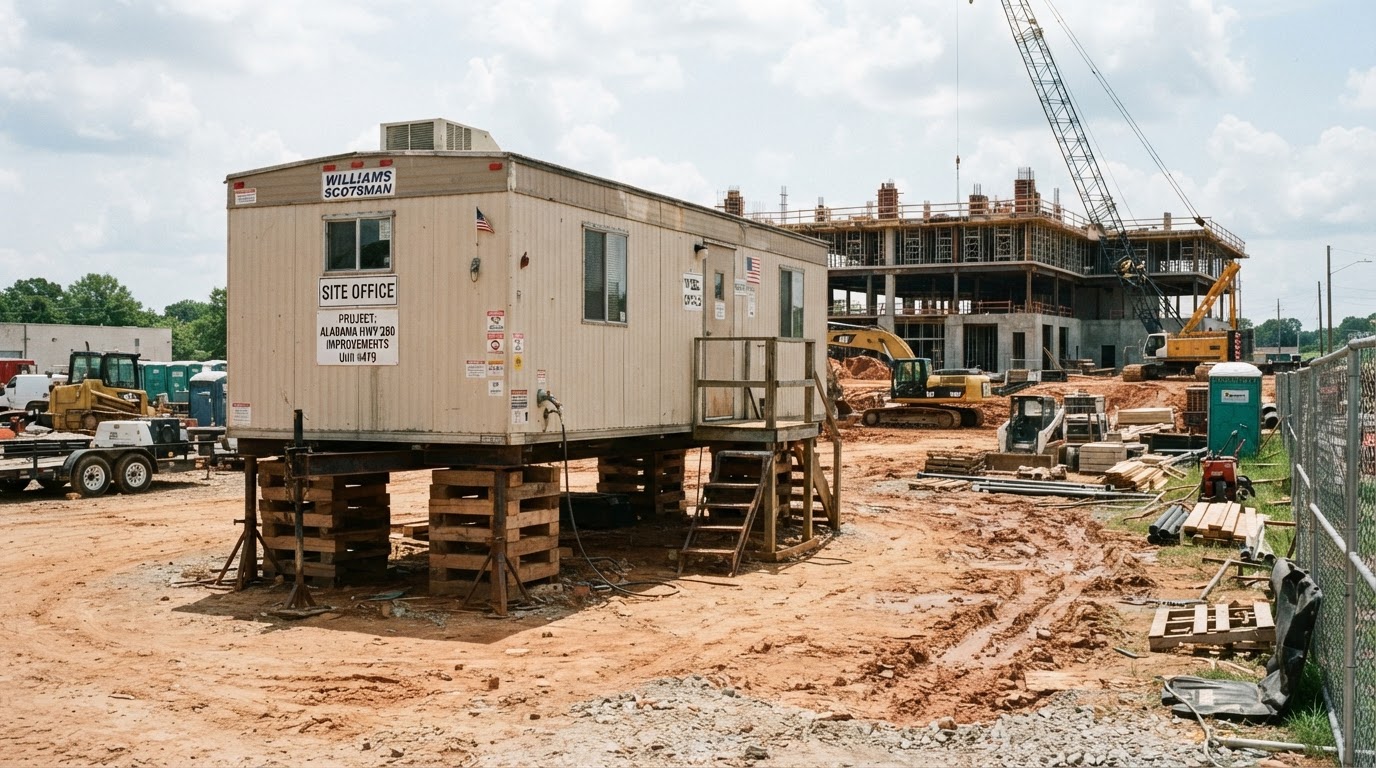
Construction Site Trailer Leveling Montgomery
A construction site trailer is a temporary structure on a temporary support system, placed on ground that is actively changing around it. This page explains how leveling and support concerns are evaluated for site trailers near Montgomery — with attention to trailer type, changing ground conditions, and site coordination — without claiming the business provides transportation, crane services, utility installation, or guaranteed rapid deployment.
Construction Trailer Leveling Considerations Around Montgomery
A site trailer sits on whatever the crew placed it on, on ground that the job has been moving around. Uneven placement areas, settling under the trailer's weight, runoff across the pad, and the simple fact that the trailer may stay longer than the supports were planned for can each show up as a floor that slopes or a door that no longer closes. Those are reasons to request an assessment — not proof that one fix applies.
Uneven placement areas
Changing ground conditions
Drainage & surface runoff
Trailer relocation
Door & floor alignment
Site-specific safety
A site trailer is not a permanent foundation
Identifying What the Trailer Needs
The evaluation starts with the trailer itself — its type, manufacturer requirements, and the existing support equipment — and the site: ground conditions, intended use, the planned duration of placement, and the relevant project authority. From there the request is reviewed to identify what assessment or support adjustment may be appropriate and what qualified parties may need to be involved.
1 · Note the trailer type
Office, storage, or site trailer.2 · Identify existing supports
Cribbing, stands, or blocks.3 · Describe ground conditions
Compaction, drainage, grade.4 · Note intended use & duration
How long it stays.5 · Identify the project authority
Who governs the site.
Coordination on an Active Site
A site trailer is evaluated in the middle of an active job, so coordination is part of the work: contractor access, active construction around the pad, placement restrictions, utility coordination by authorized parties, site safety, applicable permits, and relocation considerations. The assessment accounts for the site as it is, not as it was when the trailer was dropped.
Contractor access
Active construction
Placement restrictions
Utility coordination
Site safety
Permits & documentation
No transportation, crane, or rapid-deployment claims
Construction Site Trailer Leveling Questions Near Montgomery
Common questions from contractors, project managers, and site operators.
Discuss an Assessment for Your Site Trailer
If a construction site trailer is uneven or has shifted since placement, describing the trailer type, the existing supports, the ground conditions, and the site context helps organize an assessment. Where details are unknown, a clear “not sure” is acceptable.
Your inquiry will be reviewed and you will be contacted about appropriate next steps. No scheduling, scope, or deployment is confirmed before the trailer and site are evaluated, and any arrangement is discussed and agreed before work proceeds.