Alabama Licensed Installer Requirements for Manufactured Homes
An authoritative guide to understanding Alabama Manufactured Housing Commission (AMHC) installer certification, distinguishing certified installers from general contractors or movers, verifying active credentials, and protecting your manufactured home installation.
Does Alabama require a specialized license or certification to install a manufactured home?
Yes. Under Alabama Code Title 24, Chapter 5 and AMHC Administrative Rule 535-X-12, any person or company that installs, blocks, levels, or anchors a manufactured home in Alabama must hold active certification as a Manufactured Home Installer issued by the Alabama Manufactured Housing Commission. General building contractor licenses, home builder licenses, and moving/hauling permits do NOT substitute for this specialized state credential. Certified installers must complete state-approved training, pass an examination, maintain verified commercial liability insurance, obtain annual renewals, and affix an official AMHC installation decal to every home they install.
1. Who Qualifies as a Manufactured Home Installer?
In the construction industry, trades frequently overlap, leading many homeowners to assume that any licensed builder or experienced mover can set up and secure a manufactured home. In Alabama, state law explicitly separates these functions.
A manufactured home is an engineered structural system built on an integral steel chassis. Its installation demands precise knowledge of chassis camber, point-load pier spacing under marriage lines, ground anchor holding capacities in varied soil classes, and DAPIA-approved manufacturer setup instructions. Consequently, the Alabama Legislature created a dedicated regulatory category: the AMHC Certified Manufactured Home Installer.
AMHC-Certified Installer
Authorized by the State of Alabama to perform site blocking, pier construction, floor leveling, marriage-line bolted connections, and ground anchor installation for manufactured homes. Required to purchase and affix AMHC decals.
Transporter / Commercial Carrier
Licensed by state and federal transportation authorities (ALDOT, USDOT) to haul oversize loads on public highways. Transport authority ends once the home is pulled onto the site; movers cannot level or anchor without separate AMHC certification.
Licensed Residential Home Builder
Holds a license through the Alabama Home Builders Licensure Board (HBLB) for site-built residential construction. This credential does not authorize manufactured-home installation or state decal issuance under AMHC rules.
Utility Contractors (Plumbers & Electricians)
Licensed by their respective state trade boards (Plumbers & Gas Fitters Board, Electrical Board) to perform final service hookups from site utility meters to the home's service entry. Certified installers do not replace licensed electricians or plumbers.
2. Alabama Installer Certification Requirements (AMHC Rule 535-X-12)
To obtain and maintain installer certification in Alabama, an applicant must satisfy rigorous administrative and technical prerequisites established by the Alabama Manufactured Housing Commission:
- State-Approved Training Course: Applicants must complete an initial comprehensive training course covering HUD 24 CFR Part 3285, AMHC Chapters 535-X-12 and 535-X-13, soil classifications, pier construction, wind zones, and tie-down mathematics.
- Written Examination: Prospective installers must pass a formal written examination administered by the AMHC demonstrating mastery of installation codes, manufacturer instructions, and safety tolerances.
- Verified Commercial General Liability Insurance: Installers must file and maintain continuous proof of commercial liability insurance with the AMHC to protect property owners against installation damage.
- Annual Certification Renewal: Certification is not permanent; installers must renew annually (licenses expire December 31) and complete continuing education to remain informed of code revisions and emerging installation standards.
- Installation Decal Program Participation: Certified installers are issued an individual certification number and are required to purchase and affix state decals to every unit they site.
3. How Homeowners Can Verify Installer Credentials
Never rely on a company logo, a business card, a yard sign, or an oral assurance that an installer is 'licensed and insured.' Verifying active standing takes only a few minutes through official state resources.
Visit the official Alabama Manufactured Housing Commission Licensee Search portal at amhc.alabama.gov (or licensesearch.alabama.gov/amhc). You can search by individual name or business entity. Verify three critical items:
1. Active Status
Ensure the installer's certification is currently marked 'Active' for the current calendar year. Licenses expire December 31; check that the renewal has been processed.
2. License Classification
Confirm the licensee holds a 'Manufactured Home Installer' credential, not merely a Retailer, Broker, or Transporter registration.
3. Direct Insurer Certificate
Ask the installer's insurance agent to email a Certificate of Insurance listing you or your property address as the certificate holder.
4. State Decal Assurance
Confirm in writing that the installer will purchase and affix the official AMHC installation decal upon job completion.
4. Who Is Responsible for Different Parts of a Siting Project?
A manufactured home installation involves multiple interdependent phases. Confusion over which trade is responsible for which phase is a primary cause of project delays and disputed costs:
Site Preparation & Drainage
Responsibility: Property Owner / Grading Contractor. The property owner must ensure the lot is cleared, access roads are passable, and the pad is crowned or graded to prevent standing water beneath the footprint.
Transport & Delivery to Site
Responsibility: Licensed Transporter. Moving the home sections over public roads, securing highway permits, providing escort vehicles, and pulling sections onto the prepared pad.
Blocking, Leveling & Anchoring
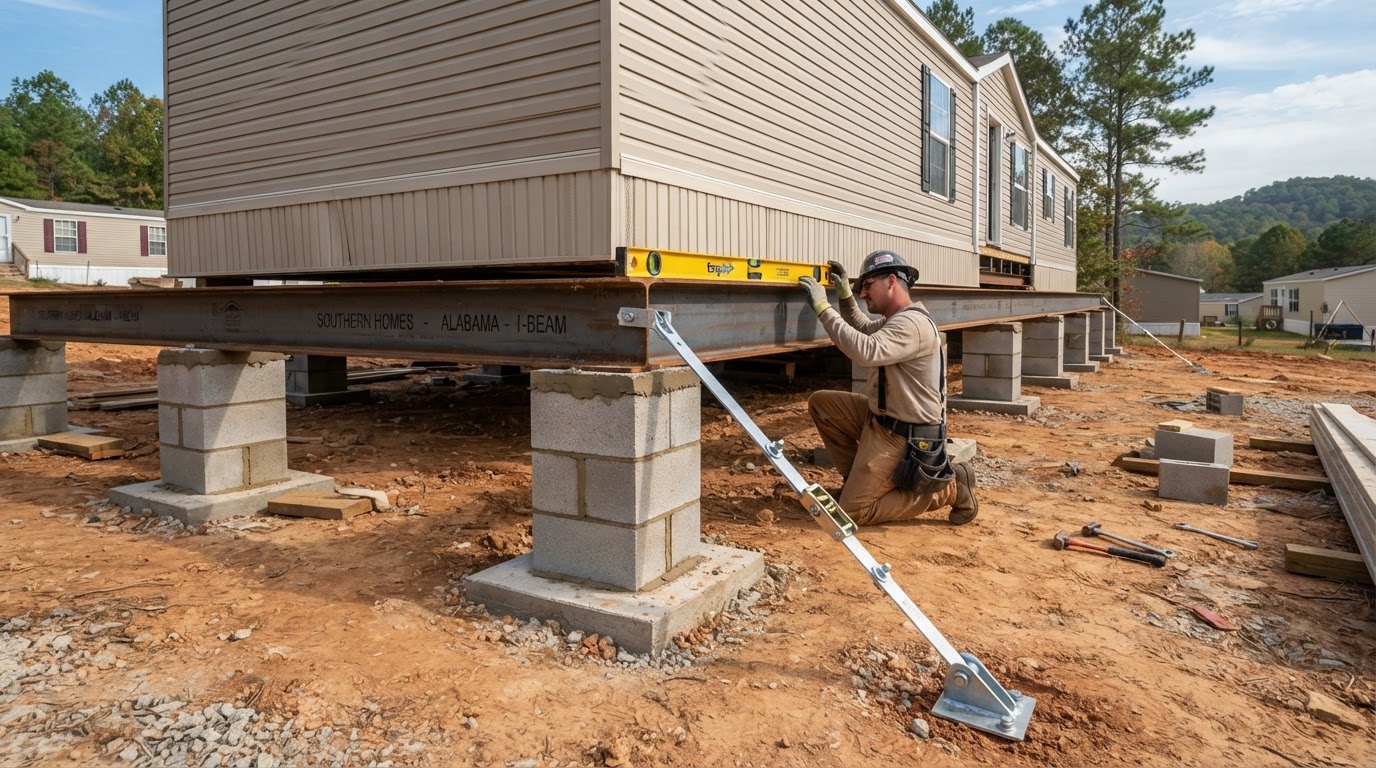
Responsibility: AMHC-Certified Installer. Positioning footings/piers, leveling the chassis with precision water or laser levels, joining multi-section marriage lines, and torquing ground anchors.
Utility Connections (Power, Water, Gas, Septic)
Responsibility: Licensed Plumber, Electrician, HVAC Contractor. Hooking up site service to the home's connection points and obtaining municipal/county trade inspection sign-offs.
5. Warning Signs When Hiring an Installation or Foundation Contractor
Protecting your home begins with identifying red flags before signing a contract or paying a deposit. Homeowners in Central Alabama should be cautious if a contractor exhibits any of the following behaviors:
Refusal to Provide AMHC License Number
An installer who claims they are 'working under someone else's license' or cannot produce their individual AMHC certification number should not be hired.
No Mention of the State Installation Decal
If a contractor states that an AMHC decal is 'optional' or 'just government paperwork,' they are likely uncertified and attempting to avoid state field audit oversight.
Vague or Oral-Only Quotes
Professional installers provide a written scope detailing pier spacing, pad types (ABS or concrete), anchor count, stabilizer plate inclusion, and leveling tolerances.
Promises of Unverified Loan Approvals
No contractor can guarantee that an installation will automatically satisfy a future FHA, VA, or conventional lender's foundation certification without an independent engineering review.
6. Questions Every Homeowner Should Ask Before Hiring
Use this structured questionnaire when interviewing prospective manufactured home installers or foundation contractors in Montgomery, Autauga, or Elmore County:
10-Question Installer Evaluation Checklist
- 1What is your AMHC Installer Certification number?Request the exact number so you can verify active standing through the online AMHC portal before signing.
- 2Will an official AMHC installation decal be affixed to the home?Confirm that decal purchase and placement is included in the project scope and invoice.
- 3Are you insured for commercial general liability in Alabama?Ask for an insurance certificate sent directly from the insurer or agency showing active coverage.
- 4Will the setup follow the manufacturer's DAPIA-approved manual?Verify that the installer has reviewed the specific manual for your make, model, and year.
- 5How will ground conditions and soil bearing capacity be evaluated?Inquire about soil torque-probe testing or soil class determination to ensure correct footing sizing and anchor selection.
- 6Are steel stabilizer plates included with all diagonal wind anchors?Ensure stabilizer plates are specified in writing; anchors without plates fail lateral wind-load standards.
- 7Who coordinates local municipal or county permits?Clarify whether the installer, property owner, or utility trades pull local siting, electrical, and plumbing permits.
- 8What precision tools will be used for leveling?Professional setups rely on electronic water levels or digital laser transits, not short carpenter levels on chassis beams.
- 9How are multi-section marriage lines joined and sealed?For double-wides and triple-wides, confirm that floor, wall, and roof structural fasteners and weather-tight gasket seals are included.
- 10What warranty or follow-up re-leveling service is provided?Ask whether the installer offers a post-settlement inspection or adjustment period following initial soil compaction.
Verify current rules directly with the responsible federal, state, and local agencies:
- AMHC Installer Licensing Division
Official portal for Alabama manufactured home installer applications, training schedules, renewal procedures, and decal purchasing.
- Alabama Licensee Search Portal
Public directory to verify active standing of Alabama-certified manufactured home installers, retailers, and manufacturers.
- HUD Manufactured Home Installation Program (24 CFR Part 3286)
Federal regulations establishing national installation oversight and model installation standards.
Regulatory Notice: This guide provides general educational information. Requirements can change and may vary by property location and project scope. Confirm current rules with the applicable government agency and qualified professionals before beginning work. Last verified: November 2026. Research verified November 2026.
Frequently Asked Questions
Related Alabama Foundation & Setup Services
Explore related services and educational guides for manufactured-home foundation care across Montgomery and Central Alabama:
Planning an Installation or Foundation Evaluation in Central Alabama?
Request a Leveling Assessment to discuss your site conditions, foundation requirements, and coordination needs with an experienced assessment coordinator.
Inquiries are coordinated for residential and commercial manufactured homes across Montgomery, Autauga, and Elmore counties.