
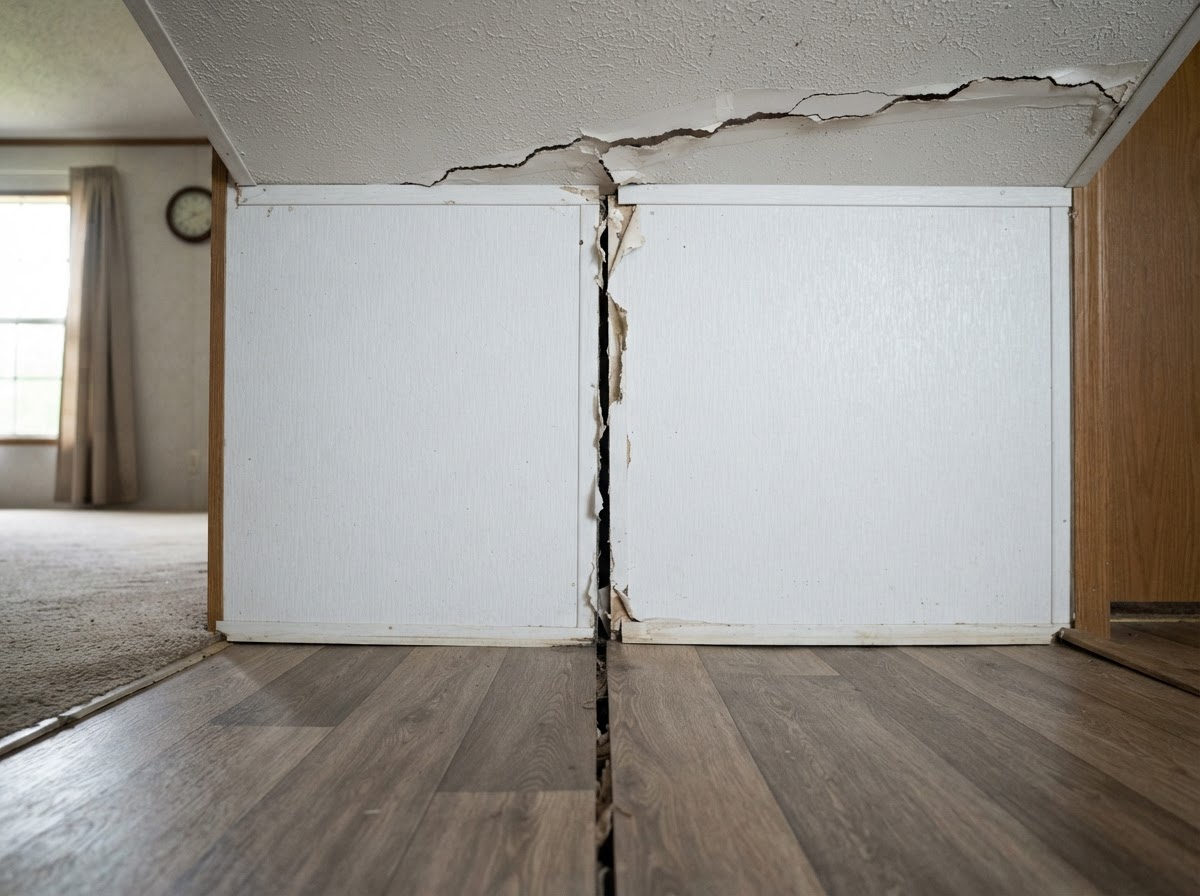
Gaps at the Marriage Line in Montgomery Mobile Homes
In a double-wide or multi-section manufactured home, the marriage line is the seam where two sections join. It is a built joint, not a continuous surface — which is also where small alignment or finish changes tend to show up first. When a visible gap, a floor height difference, or a ceiling seam opens along that line, it is a reason to request an assessment. It is not, by itself, proof that the home has settled or that leveling is required.
This page explains why marriage-line gaps develop in manufactured homes near Montgomery, how they are distinguished from other concerns, and when an assessment may be appropriate. It does not claim that every gap requires leveling, and it does not publish lifting, fastening, or section-adjustment instructions.
Why Marriage Line Gaps Develop in Double-Wide Homes Near Montgomery
A marriage line joins two separately built sections at installation. Because each section rests on its own supports and was finished separately before being fastened together, the joint reflects whatever happens to either side — finish movement, alignment differences, support changes, or moisture. A gap at that joint can have a cosmetic cause, a structural cause, or both, and the cause is not determined by the size or shape of the gap alone.
Finish-Material Movement
Differences in Section Alignment
Support Settlement
Framing Concerns
Moisture-Related Changes
Previous Alterations
A gap is a symptom, not a verdict
The same visible gap can come from the finish, the framing, the supports, or the ground — or from a combination. Which one it is gets determined through an assessment of the actual home and site, not from the appearance of the gap by itself.
Different Kinds of Gaps at the Marriage Line in Montgomery Homes
Not every gap is the same kind of concern. Where the gap sits and what it accompanies matters as much as how wide it is. The distinctions below help frame what an assessment looks at — they are not a self-diagnosis tool, because the same gap can have more than one cause.
Floor Transitions
Interior Wall Seams
Ceiling Joints
Trim Separation
Exterior Joint Concerns
Accompanying Symptoms
What an Assessment Looks For, and What It Does Not Do
An assessment for a marriage-line gap reviews the home configuration, the visible conditions at the joint, the supports beneath, and any moisture or drainage context — then identifies which response may actually be appropriate. That response is not always leveling, and it is not the same for every home.
Cosmetic Finish Repair
Where a gap is finish movement only, the appropriate response is finish repair — not leveling or foundation work. Treating a cosmetic gap as a structural problem is a common and avoidable misstep.
Marriage-Line Repair
Where the joint connection itself is the concern, marriage-line repair addresses the fastening and finish between sections — separate from support alignment.
Re-Leveling
When a genuine elevation difference between sections reflects support movement, re-leveling may be relevant. Whether it is, and what scope it involves, is determined for the home.
Foundation Assessment
Where piers, footings, or the ground beneath are the concern, the assessment may point toward foundation work rather than leveling alone.
Support-System Work
Deteriorated piers, pads, or footings may need attention whether or not leveling is also involved. Support condition and alignment are related but separate.
Moisture-Related Repairs
Where drainage or moisture is contributing, addressing the water source is part of the response — enclosing a joint without resolving moisture leaves the underlying concern in place.
No lifting sequence, section-adjustment procedure, or fastening specification is published here. Structural work at a marriage line is determined and performed by the appropriate qualified party for the specific home and site — not from a generic instruction.
Marriage Line Gap Questions Near Montgomery
Common questions from owners of double-wide and multi-section manufactured homes about gaps at the marriage line.
Related Leveling & Repair Services
- Marriage Line RepairThe service for joint connection and finish work
- Double-Wide LevelingTwo-section alignment and support concerns
- Triple-Wide & Multi-Section LevelingLarger multi-section configurations
- Mobile Home Foundation RepairWhen findings point to the supports
- Contact & Assessment InquiryDescribe the gap and what you have noticed
Discuss a Marriage-Line Gap in Your Multi-Section Home
If you have noticed a gap, a floor height difference, or separation along the marriage line of a double-wide or multi-section home near Montgomery, describing what you see — where it is, how long it has been there, and whether it is accompanied by uneven floors, binding doors, or moisture — helps frame an assessment. Where a detail is unknown, a clear “not sure” is fine.
Your inquiry will be reviewed and you will be contacted about appropriate next steps. Whether the right response is cosmetic, structural, or something else is determined for your home — not assumed from the gap alone.