
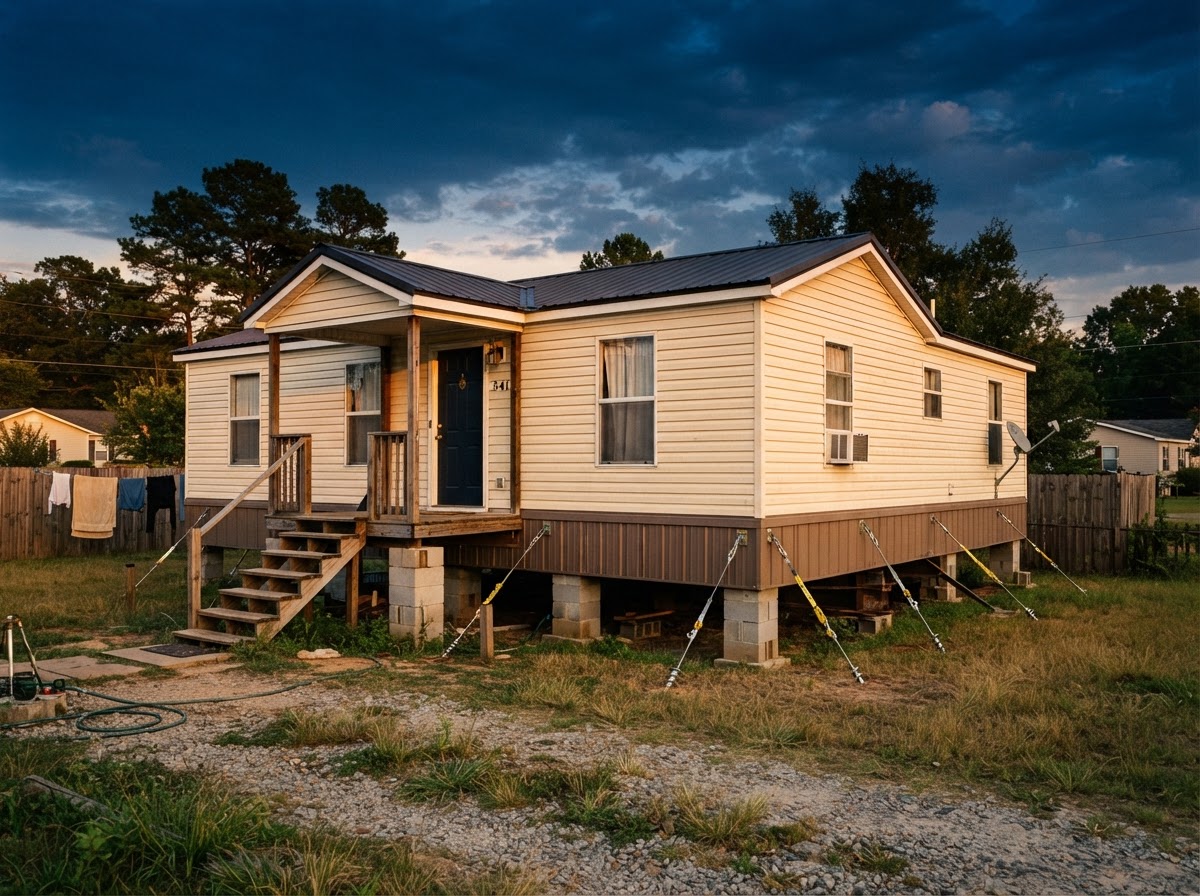
Mobile Home Leveling, Anchoring & Tie Downs Titus
Manufactured-home owners in the Titus area may encounter leveling, support, anchoring, and drainage concerns in a smaller-community setting. This page outlines the services available for discussion and how to request an assessment.
Common Mobile Home Foundation Concerns in Titus
Titus-area homeowners sometimes notice changes that may relate to a manufactured home's support or drainage conditions. These are possible concerns to describe in an inquiry — not conditions affecting every home.
Uneven or sloping floors
Doors and windows that bind or no longer close properly
Visible pier, pad, or footing deterioration
Corroded or damaged tie-down straps and hardware
Crawl-space moisture or drainage concerns
Marriage-line separation in multi-section homes
Changes in older homes with unknown repair history
Mobile Home Leveling & Re-Leveling in Titus
Leveling and re-leveling address a home's supported position. The appropriate response depends on what an assessment finds, and drainage and crawl-space conditions can be contributing factors.
- Single-wide and double-wide leveling
- Manufactured home re-leveling after settlement
- Evaluating older manufactured-home support systems
- Distinguishing leveling from pier, footing, or framing problems
- Multi-section alignment and marriage-line considerations
- When foundation repair — rather than leveling — may be relevant
Anchoring, Tie-Downs & Storm Preparation Near Titus
Anchoring and tie-down systems contribute to a manufactured home's stability under its applicable design conditions. Their condition and suitability depend on the home, the approved system, and the site.
- Evaluation of existing anchors, straps, and hardware
- Tie-down strap condition and visible deterioration
- Whether damaged straps always require full system replacement
- Manufacturer requirements and applicable Alabama regulations
- The relationship between anchoring and foundation supports
- When a more detailed anchoring evaluation may be appropriate
Piers, Pads, Footings & Foundation Systems in Titus
Piers, pads, and footings carry the home's load. Repair scope depends on the home, the site, and the applicable design — not a universal specification.
- Mobile home pier replacement for damaged supports
- Concrete pier and footer installation considerations
- ABS pad installation and support-pad suitability
- Mobile home foundation repair for broader concerns
- Foundation inspections to evaluate condition before repairs
- Assessing pier deterioration on older homes
Skirting, Underbelly & Moisture Concerns in Titus
Drainage and crawl-space conditions can influence a manufactured home's support system over time, and distinguishing existing drainage concerns from assumed flood exposure matters for an accurate assessment.
- Crawl space drainage for standing water or persistent dampness
- Underbelly repair for wet or damaged materials
- Vapor barrier installation and ground-moisture considerations
- Skirting installation and enclosure planning
- Vinyl skirting repair and replacement
- How moisture can affect support components over time
Assessment Process & Project Planning for Titus
Describing your home and the symptoms you have noticed helps determine the appropriate evaluation. A typical inquiry moves through these steps:
- 1Submit an assessment request describing your home and symptoms.
- 2Share your property location and home configuration.
- 3Describe access conditions and any visible concerns you can safely observe.
- 4The inquiry is reviewed to determine the appropriate evaluation.
- 5A recommended scope is discussed, with no obligation to proceed.
- 6Any relevant approvals, permits, or specialist involvement are clarified.
- 7Next steps and scheduling are discussed — with availability confirmed rather than guaranteed.
Titus Community & Property Context
Titus is a smaller community in Elmore County associated with the Lake Jordan area. That geographic setting is worth noting, but it would be inaccurate to describe every Titus property as waterfront or to imply that Lake Jordan automatically causes foundation instability. A property's actual conditions — parcel grading, drainage, and existing support arrangements — determine what an assessment finds, not the community's lake association alone. Waterfront and non-waterfront properties can present very different conditions.
Titus's smaller-community setting means many inquiries involve manufactured homes on individual residential parcels. That context shapes the questions worth asking: how property-specific access affects foundation work, whether existing support systems match the manufacturer's intended arrangement, and whether drainage on the parcel has changed over time. A home on an established parcel may have support components that have been modified over the years with limited documentation.
For Titus homeowners, an important distinction is between existing drainage concerns and assumed flood exposure. A property that experiences surface runoff or crawl-space moisture is not necessarily in a floodplain, and a property near Lake Jordan is not necessarily unstable. Drainage and floodplain questions should be checked against the actual parcel with the responsible authority rather than assumed from the community's name. Visible symptoms and confirmed structural defects are also distinct — an observation does not by itself establish a diagnosis.
Because Titus is an unincorporated community within Elmore County, the responsible authority for permitting and land-use questions is typically Elmore County, and state manufactured-housing installation oversight applies separately. Confirming the specific jurisdiction helps ensure that planned work aligns with the property's actual requirements. For homeowners evaluating an older manufactured home, the most useful questions involve documentation, drainage history, and prior repairs, all of which help frame an accurate, site-specific assessment.
- Elmore County GovernmentCounty-level land-use, drainage, and development resources for Titus and surrounding unincorporated Elmore County parcels.
This guide provides general educational information. Requirements can change and may vary by property location and project scope. Confirm current rules with the applicable government agency and qualified professionals before beginning work.
Titus FAQs, Related Services & Inquiry
Frequently Asked Questions
Related Services & Resources
Request a Leveling Assessment for Your Titus Home
If you have noticed changes in your floors, doors, supports, or the area beneath your home, describing the situation helps determine whether leveling, support, anchoring, or moisture work is the appropriate next step.
Share your home's configuration and location and the concerns you are noticing. Your request will be reviewed and you will be contacted about appropriate next steps — with no obligation to proceed and no guaranteed scheduling before conditions are evaluated.