HUD Wind Zones for Alabama Mobile Homes Explained
An authoritative guide to understanding HUD Manufactured Home Wind Zones in Alabama, reading factory data plates, matching home wind design ratings to installation site requirements, and evaluating ground anchor systems across Central Alabama.
What HUD Wind Zones apply to manufactured homes in Alabama?
Under federal HUD standards (24 CFR § 3280.305(c)(2)), Alabama is divided into two distinct Wind Zones: Wind Zone I (Interior) and Wind Zone II (Coastal). Inland counties—including Montgomery, Autauga, Elmore, Macon, Lowndes, Dallas, and Bullock—fall in Wind Zone I, designed to withstand basic wind speeds of 70 mph. Coastal Mobile and Baldwin counties are designated Wind Zone II, designed for higher hurricane wind loads up to 100 mph. Under federal and state rules, a home designed for a lower wind zone (e.g., Wind Zone I) cannot legally or safely be relocated and installed in a higher wind zone (e.g., Wind Zone II). However, a Wind Zone II or Wind Zone III home can be installed in Wind Zone I.
1. What Is a HUD Wind Zone?
In 1976, the U.S. Department of Housing and Urban Development (HUD) established national structural standards for manufactured homes under the Manufactured Home Construction and Safety Standards (24 CFR Part 3280). Following Hurricane Andrew in 1992, HUD significantly updated wind-load regulations in 1994, establishing three distinct geographic Wind Zones across the United States:
Wind Zone I (Interior)
Applies to inland regions across the U.S., including Central and Northern Alabama. Structures are engineered to resist basic design wind pressures corresponding to 70 mph basic wind speeds.
Wind Zone II (Coastal)
Applies to coastal areas prone to tropical storms and hurricanes, including Mobile and Baldwin counties in Alabama. Engineered to withstand design wind pressures for 100 mph wind speeds.
Wind Zone III (Extreme Coastal)
Applies to high-risk coastal zones in southern Florida, Louisiana, and Atlantic islands. Engineered for 110 mph design wind pressures.
Critical Design Distinction
Wind Zone ratings reflect factory structural framing, exterior shear wall fastening, roof truss uplift resistance, and window design pressures—not merely adding extra ground tie-down straps on site.
2. How to Identify Your Home's Wind Zone: Data Plates & HUD Labels
Every HUD-code manufactured home leaves the factory with two primary identification features that document its structural design limits:
- Interior Factory Data Plate: A paper document (approximately 8.5 x 11 inches) permanently affixed inside the home during manufacturing. Common locations include inside the master bedroom closet wall, inside a kitchen cabinet door, or inside the electrical service panel door.
- Data Plate Information: Contains the manufacturer name, plant location, serial number, model designation, date of manufacture, and three distinct environmental maps: Wind Zone Map, Roof Load Zone Map, and Thermal (Comfort) Zone Map.
- Exterior HUD Certification Labels: Metal red tags (approx. 2 x 4 inches) riveted to the exterior siding at the rear left corner of each transport section, embossed with a 3-letter state prefix and 6-digit section number.
- Missing Data Plates: If the interior paper data plate has been painted over or removed, an owner can request a Data Plate Performance Verification Certificate through the Institute for Building Technology and Safety (IBTS), HUD's official data plate contractor.
3. How Wind Zones Relate to Alabama Locations
Understanding Alabama's geographic wind map is crucial when buying a used manufactured home, planning a relocation, or verifying site compliance:
Central Alabama (Montgomery, Autauga, Elmore)
Designated HUD Wind Zone I. Homes installed in Montgomery, Wetumpka, Millbrook, Prattville, Clanton, Selma, and Tuskegee must meet Wind Zone I (or higher) design ratings.
Coastal Alabama (Mobile & Baldwin Counties)
Designated HUD Wind Zone II. Homes installed near Gulf Shores, Orange Beach, Foley, Fairhope, Daphne, Mobile, or Bayou La Batre MUST be rated Wind Zone II or Wind Zone III.
Relocation Rule
A Wind Zone I home purchased in Montgomery CANNOT legally be relocated to Mobile or Baldwin County. However, a Wind Zone II home purchased in Mobile CAN be legally relocated and installed in Montgomery.
Roof Load & Thermal Zones in Alabama
Entire state of Alabama is classified in the Middle Roof Load Zone (20 lbs/sq ft) and Thermal Zone 1 (Southern climate zone).
4. Wind Zones and Ground Anchoring Systems
While Wind Zone ratings dictate factory wall and roof strength, the home relies on on-site ground anchoring to transfer wind forces safely into the earth. Ground anchoring rules under AMHC Chapter 535-X-13 and HUD 24 CFR Part 3285 specify:
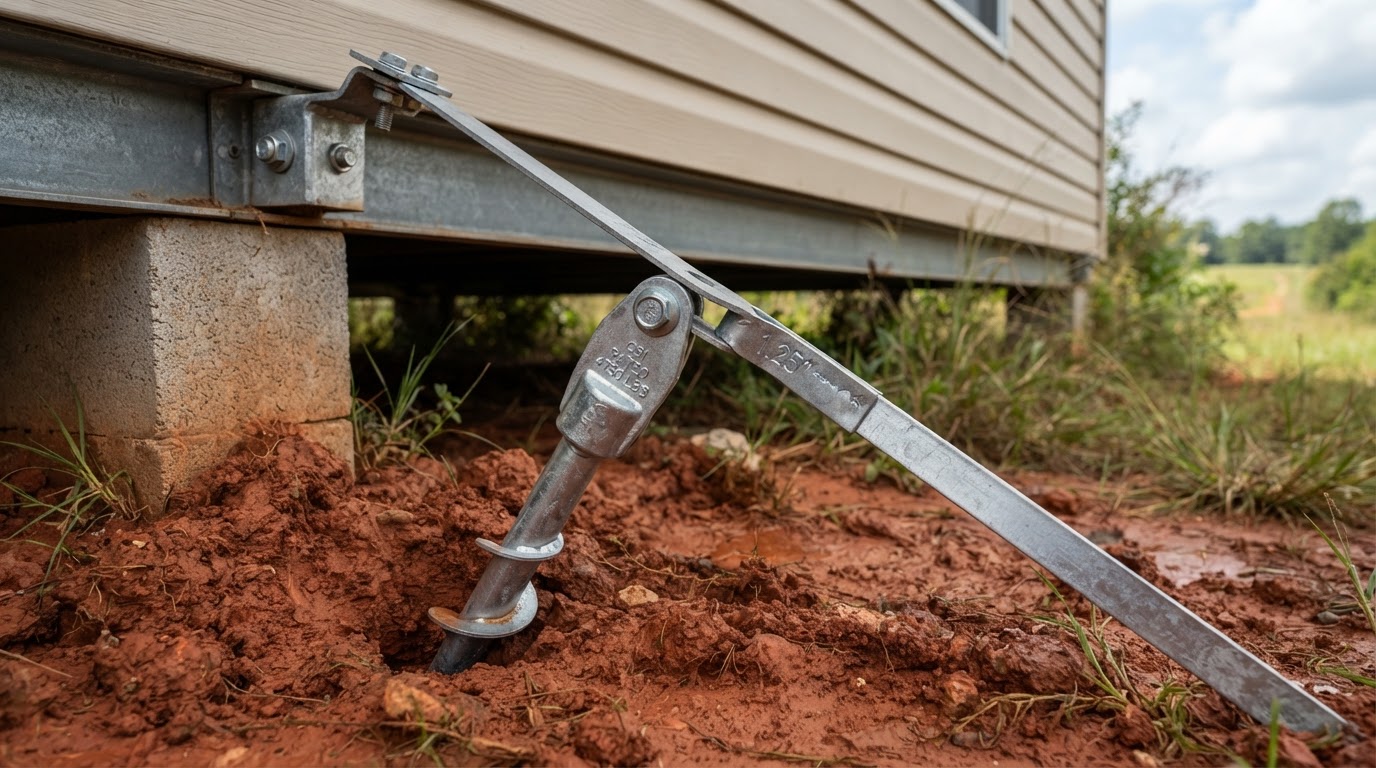
- Diagonal & Vertical Tie-Down Straps: Galvanized steel strapping (1.25 inch x 0.035 inch, Grade 1) connecting chassis I-beams and wall studs to ground anchors.
- Ground Anchor Types: Helical or auger-type steel anchors driven into undisturbed soil. In Central Alabama's Class 4B and Class 5 heavy clay soils, anchor length and helix diameter must match soil torque probe readings.
- Stabilizer Plates Mandatory: Steel stabilizer plates (minimum 10 x 18 inches) driven vertically alongside the anchor shaft on the home side are mandatory. Stabilizer plates prevent the anchor shaft from slicing laterally through damp topsoil under wind load.
- Anchor Spacing & Count: Maximum anchor spacing depends on home width, roof pitch, wind zone, and wall height. Multi-section homes require dedicated marriage-line endwall anchors and column pier uplift ties.
5. Common Wind-Zone Mistakes to Avoid
Homeowners, buyers, and park managers frequently fall victim to costly misunderstandings regarding wind ratings and foundation anchor systems:
Mistake 1: Assuming Extra Straps Change the Home's Wind Zone
Adding additional ground anchors to a Wind Zone I home does NOT convert it into a Wind Zone II home. Anchors secure the chassis, but cannot alter factory wall framing or roof truss uplift resistance.
Mistake 2: Buying a Coastal Home Without Verifying Data Plate
Purchasing a used home from a coastal county assuming it is Wind Zone II without checking the paper data plate can lead to severe disappointment if the unit was originally a Wind Zone I home incorrectly sited.
Mistake 3: Confusing Wind Zone with Roof Load Zone
Wind Zones govern horizontal and uplift wind pressure; Roof Load Zones govern snow/live roof capacity. Alabama requires Middle Roof Load capacity across all counties.
Mistake 4: Ignoring Corrosion on Anchor Straps
Galvanized straps exposed to damp soil or crawl-space moisture deteriorate over time. Rusted or loose straps reduce wind resistance and should be replaced by an AMHC-certified installer.
6. Wind-Zone & Anchoring Verification Checklist
Follow this practical sequence to verify wind zone compatibility and anchoring health for your manufactured home:
Homeowner Wind Zone & Anchoring Checklist
- 1Locate Interior Factory Data PlateInspect master closet walls, electrical panel doors, or kitchen cabinet interiors to locate the original factory paper document.
- 2Record Home Design Wind Zone RatingConfirm whether the document specifies Wind Zone I, Wind Zone II, or Wind Zone III.
- 3Identify Intended Installation Parcel CountyConfirm whether the property is in Wind Zone I (Central/North Alabama) or Wind Zone II (Mobile/Baldwin counties).
- 4Verify Wind Zone CompatibilityEnsure the home's design rating equals or exceeds the destination county's wind zone requirement.
- 5Inspect Exterior Ground Anchor StrapsExamine tie-down straps for rusted, severed, or loose tensioning. Verify steel stabilizer plates are present at every diagonal anchor.
- 6Check Marriage-Line Uplift ConnectionsOn double-wide and triple-wide homes, verify that roof marriage-line uplift straps and column pier ties are properly fastened.
- 7Retain Data Plate Records for Lenders & InsurersKeep clean photographs of the data plate and exterior red HUD certification labels in your permanent property binder.
Verify current rules directly with the responsible federal, state, and local agencies:
- HUD Office of Manufactured Housing Programs (OMHP)
Federal regulatory agency governing 24 CFR Part 3280 Manufactured Home Construction and Safety Standards, including Wind Zone maps.
- Institute for Building Technology and Safety (IBTS)
Official HUD contractor providing data plate verification certificates and label history reports for manufactured homes.
- Alabama Manufactured Housing Commission Rules (Chapter 535-X-13)
State installation rules specifying tie-down strap requirements, anchor types, and stabilizer plate standards in Alabama.
Regulatory Notice: This guide provides general educational information. Requirements can change and may vary by property location and project scope. Confirm current rules with the applicable government agency and qualified professionals before beginning work. Last verified: November 2026. Research verified November 2026.
Frequently Asked Questions
Related Alabama Foundation & Setup Services
Explore related services and educational guides for manufactured-home foundation care across Montgomery and Central Alabama:
Concerned About Your Home's Anchoring or Wind Resistance Condition?
Request a Leveling Assessment to discuss your visible symptoms, tie-down strap condition, and ground anchor placement with an assessment coordinator.
Inquiries are coordinated for residential and commercial manufactured homes across Montgomery, Autauga, and Elmore counties.