
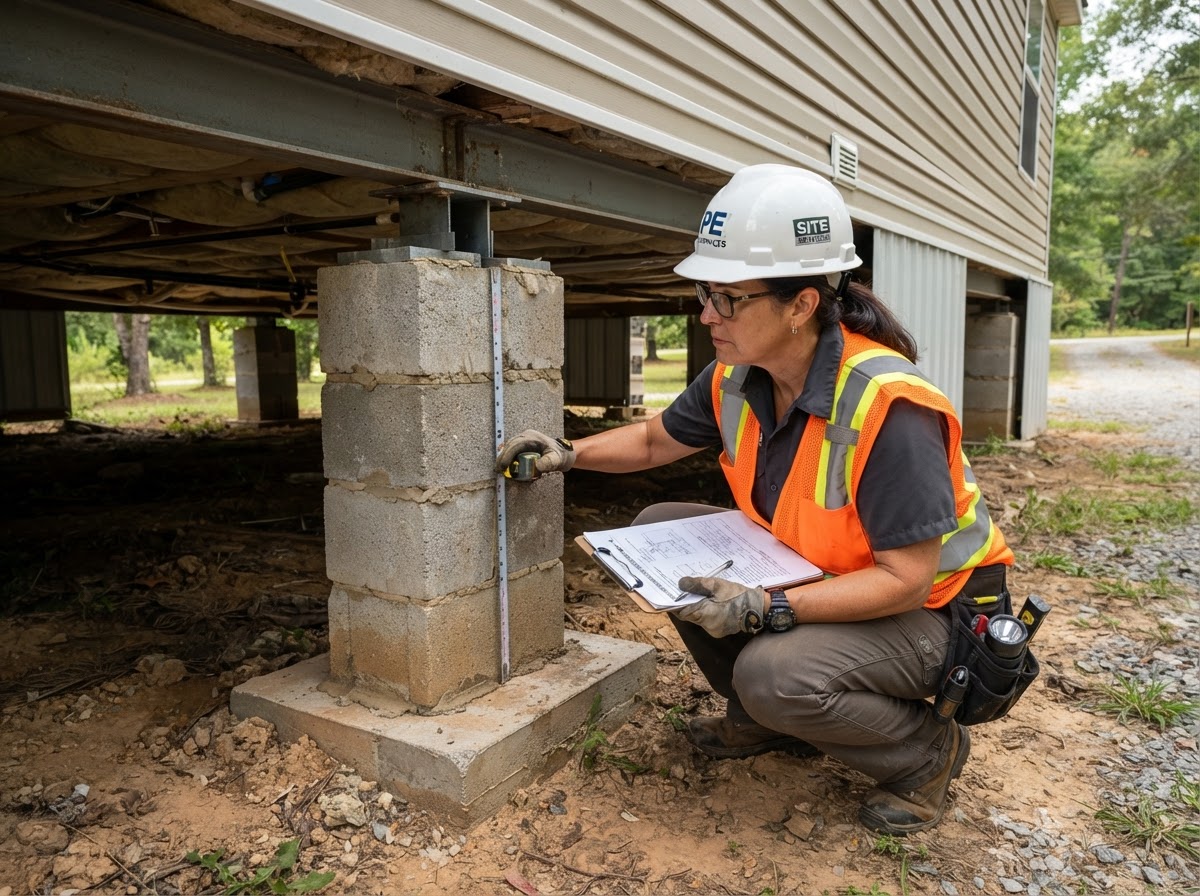
Engineer's Foundation Certification for Manufactured Home Loans
A clear guide to what an engineer's foundation certification is, when a lender may request one during a manufactured-home financing transaction, how it differs from a contractor's repair work, and what Alabama homeowners should prepare before requesting a certification or repair estimate.
What is an engineer's foundation certification, and when is it required for a manufactured-home loan?
An engineer's foundation certification is a written determination, issued by a licensed professional engineer, confirming that a manufactured home's foundation meets a specific standard, most commonly HUD's Permanent Foundations Guide for Manufactured Housing (HUD-7548). FHA and some VA and conventional lenders may require such a certification when a manufactured home is financed, refinanced, or has had foundation modifications. The certification is a professional engineering determination, not a contractor's repair estimate or a general home inspection, and only a qualified, licensed engineer may issue one.
1. What Is an Engineer's Foundation Certification?
A foundation certification is a written professional determination that a manufactured home's foundation complies with a particular standard. For FHA-insured manufactured-home financing, the applicable standard is typically the Permanent Foundations Guide for Manufactured Housing (HUD-7548), referenced within the FHA Single Family Housing Policy Handbook 4000.1.
It is essential to distinguish the certification from adjacent but different documents. A certification is not the same as a general home inspection, a contractor's repair estimate, a property appraisal, or a lender's underwriting approval. Each serves a different purpose and is issued by a different professional.
This business does not issue engineering certifications. Only an appropriately qualified, licensed professional engineer may issue a foundation certification. The information below helps homeowners understand the process, prepare for an evaluation, and coordinate any physical repair work a certification report may identify.
Foundation Inspection
A general evaluation of the foundation's visible condition. May be performed by a contractor or home inspector but does not constitute an engineering certification.
Engineering Report
A licensed engineer's documented findings regarding the foundation, which may or may not include a formal certification statement depending on the scope of engagement.
Foundation Compliance Certification
A formal written certification by a licensed engineer that the foundation meets a named standard, such as HUD-7548. This is the document a lender typically requests.
Contractor Repair Estimate
A contractor's proposal to perform physical repairs. Repair work is not itself a certification; the completed work may require a subsequent engineer's re-evaluation.
Home Inspection
A broad general-property inspection covering multiple systems. Not a substitute for an engineer's foundation certification.
Property Appraisal
A lender-ordered valuation of the property. An appraisal is not an engineering determination of foundation compliance.
2. When Might a Lender Request Certification?
A lender may request a foundation certification in several common scenarios, though the exact requirement depends on the loan program, the lender's guidelines, and the property's documentation history.
Not every manufactured-home financing transaction requires an engineer's letter. Requirements depend on the applicable program and the lender's specific underwriting guidelines, which can vary even within the same loan type.
- Purchasing a manufactured home where the lender requires foundation documentation
- Refinancing an existing loan where prior foundation records are incomplete or unavailable
- Financing an older or previously installed home whose installation records cannot be verified
- Foundation modifications, re-leveling, or repairs that may have changed the original installation
- Documentation gaps where the home's original permanent-foundation status is unclear
- Lender-specific overlays that require an engineer's letter regardless of program minimums
3. FHA, VA, Conventional, and Other Loans
Different financing programs apply different foundation requirements to manufactured homes. The comparisons below are general and should be verified against the current official program guidance for the specific transaction.
FHA Loans
FHA-insured manufactured-home financing generally requires the home to be on a permanent foundation that meets the Permanent Foundations Guide for Manufactured Housing (HUD-7548), as referenced in FHA Handbook 4000.1. A licensed engineer's certification is commonly required to document compliance.
VA Loans
VA-guaranteed manufactured-home financing applies property eligibility requirements that may include a permanent foundation. Current requirements should be confirmed with the VA Lenders Handbook and the specific lender, as VA guidance differs from FHA in several respects.
Conventional Loans
Conventional manufactured-home loans follow investor and lender-specific guidelines rather than a single federal standard. Foundation documentation requirements vary by lender and may be more or less stringent than FHA or VA minimums.
Other Financing
Other programs, such as USDA or portfolio lending, may apply distinct requirements. No single engineer's report is guaranteed to satisfy every lender; the required scope and standard depend on the specific program and transaction.
4. What a Foundation Professional May Evaluate
When a licensed engineer or qualified professional evaluates a manufactured-home foundation for certification or documentation purposes, the assessment typically addresses the support configuration, the foundation's condition, the pier and footing system, evidence of settlement, drainage, anchoring, the manufacturer's documentation, applicable structural requirements, and any prior alterations.
The evaluation distinguishes observations a contractor can make from determinations that require a licensed engineer. A contractor can describe visible conditions and propose repairs; only a licensed engineer can issue the formal certification a lender may require.
- Support configuration and pier layout
- Foundation condition and evidence of deterioration
- Pier and footing system type and condition
- Settlement, movement, or differential displacement
- Drainage and moisture conditions affecting the foundation
- Anchoring system condition and compatibility
- Manufacturer documentation and installation records
- Applicable structural and regulatory requirements
- Prior alterations, repairs, or modifications
5. What if the Foundation Does Not Meet the Required Standard?
If an engineer's evaluation identifies that the foundation does not meet the required standard, a lender may require corrective work before approving the loan. The process for addressing such findings should follow a structured sequence to ensure the completed work satisfies both the engineer's requirements and the lender's underwriting.
- 1. Obtain the engineer's written findings and identified deficiencies
- 2. Clarify the specific standard the lender requires the foundation to meet
- 3. Identify each deficiency and whether engineering design is needed
- 4. Obtain a properly scoped repair proposal from a qualified contractor
- 5. Complete the approved corrective work to the specified standard
- 6. Arrange any required follow-up evaluation by the engineer
- 7. Submit the completed certification and documentation through the lender's process
6. Foundation Certification Preparation Checklist
Gathering the following information in advance can help an engineering evaluation proceed efficiently and reduce the chance of delays during a financing transaction.
Foundation Certification Preparation Checklist
- 1Property addressThe complete parcel address and jurisdiction (city or unincorporated county).
- 2Home make, model, and yearManufacturer, model name, and year of manufacture from the data plate or title.
- 3HUD label and data-plate informationHUD certification label serial numbers and the interior data plate details, where available.
- 4Existing foundation documentationAny prior installation records, engineering reports, or permits describing the current foundation system.
- 5Previous engineering reportsPrior certifications or inspection reports that may be relevant to the current transaction.
- 6Permits or installation recordsLocal building permits, AMHC installation decals, or setup documentation.
- 7Relevant photographsClear photographs of visible foundation, pier, skirting, and anchoring conditions taken from safe, accessible positions.
- 8Loan-program informationThe specific loan program (FHA, VA, conventional, or other) being pursued.
- 9Written lender requirementsAny written instructions from the lender specifying the required certification standard.
- 10Identified foundation concernsA summary of any known or suspected foundation issues to be evaluated.
Verify current rules directly with the responsible federal, state, and local agencies:
- FHA Single Family Housing Policy Handbook 4000.1
Official FHA handbook specifying manufactured-home property requirements, including permanent foundation standards referenced to HUD-7548.
- HUD Permanent Foundations Guide for Manufactured Housing (HUD-7548)
The foundation standard commonly referenced by FHA and other lenders for manufactured-home certification.
- HUD Office of Manufactured Housing Programs (24 CFR Part 3286)
Federal installation program oversight governing manufactured-home installation and foundation requirements.
Regulatory Notice: This guide provides general educational information. Requirements can change and may vary by property location and project scope. Confirm current rules with the applicable government agency and qualified professionals before beginning work. Last verified: November 2026. Research verified November 2026.
Frequently Asked Questions
Related Alabama Foundation & Setup Services
Explore related services and educational guides for manufactured-home foundation care across Montgomery and Central Alabama:
Need Foundation Repairs Before an Engineering Reinspection?
Request a Leveling Assessment to discuss the physical foundation concerns identified in an inspection report and determine whether repair coordination is the appropriate next step.
Inquiries are coordinated for residential and commercial manufactured homes across Montgomery, Autauga, and Elmore counties.