Park Model and RV Park Unit Leveling Montgomery
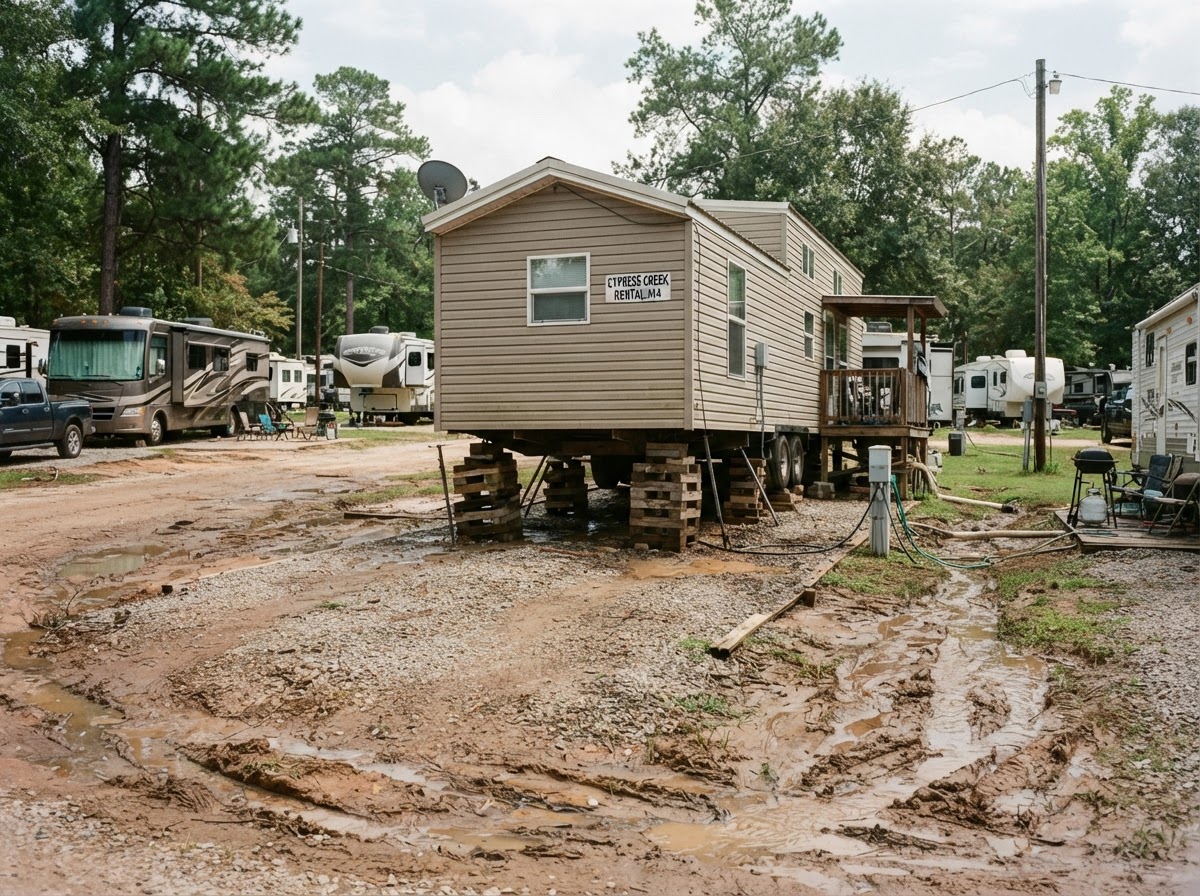
Park model homes, travel trailers, and other RV park units rest on supports that keep them level and stable — but those supports are not interchangeable with a HUD-code manufactured home's foundation system. When a park unit develops an uneven feel, shifting, or drainage-related concerns, an evaluation can help clarify whether the issue involves the supports, the site, or something else.
This page explains how a park model or RV park unit concern may be evaluated and coordinated for Central Alabama campgrounds and parks. No universal jack placement, stabilizer specification, or anchoring assumption is published here; what is appropriate depends on the actual unit and site.
Park Model and RV Unit Support Concerns Near Montgomery
RV park operators and campground managers tend to notice the same kinds of things a residential homeowner does — a unit that feels uneven, a door that no longer closes cleanly, water collecting around the supports — but the units themselves differ. A park model, a travel trailer, a fifth-wheel, and a manufactured home can each follow a different construction standard, and the right response follows the unit, not the symptom.
Uneven Unit Placement
Seasonal Ground Changes
Drainage and Moisture
Relocation and Re-Placement
Differences Among Unit Types
Access and Occupancy
Observation is not a diagnosis
An uneven park unit is a reason to request an evaluation — not a conclusion that the supports are wrong or that leveling is the fix. Whether the appropriate response is re-leveling, drainage work, a support change, or simply re-placing the unit is determined for the specific site.
Evaluating RV Park Units Around Montgomery
An assessment for a park model or RV park unit starts by identifying what the unit actually is. The manufacturer's instructions, the approved support system, and the applicable requirements all follow the unit type — and applying a residential manufactured-home procedure to a recreational unit can be the wrong move.
Actual Unit Type
Manufacturer Instructions
Existing Support Arrangement
Site Conditions
Seasonal Versus Long-Term Use
Qualified Service Providers
Park Operations, Coordination & Professional Requirements
A park model or RV unit sits inside an operating campground or park, which adds coordination that a residential project does not have. Access follows the park's schedule and rules, occupancy is coordinated with the operator, and some situations call for professional involvement beyond a contractor assessment. No universal jack placement, stabilizer, anchoring, or support specification is published here.
Site Readiness
Preparing for any work means confirming the pad is accessible, drainage is understood, and the site conditions are described accurately — rather than assuming a unit can be evaluated the same way at every site.
Occupant Coordination
On an occupied site, access is arranged through the operator and with the occupant's awareness, following the park's own communication and authorization process.
Relocation Planning
If a unit has been or will be moved, that context is part of the evaluation. This business does not claim to provide transportation, towing, or crane services for park units.
Applicable Requirements
Park model and RV units can be subject to requirements that differ from manufactured housing. Which requirements apply — and whether a qualified installer or engineer is needed — is determined for the specific unit and site.
No universal stabilizer setting, jack placement, anchor depth, or support specification is implied here. The appropriate approach for a park model or RV unit is based on the manufacturer's instructions, the approved system, the site conditions, and the applicable authority — confirmed through an inquiry, not assumed in advance.
Park Model & RV Park Unit Leveling Questions Near Montgomery
Common questions from RV park operators and park model owners about unit support, placement, and drainage.
Discuss a Park Model or RV Park Unit Concern
If a park model, travel trailer, or other RV park unit on your property feels uneven, has shifted, or has drainage concerns around its supports, describing the unit, the site, and what you have observed helps start that conversation. Share what you know — and where a detail is uncertain, that is acceptable.
Your inquiry will be reviewed and you will be contacted about appropriate next steps. No universal support or anchoring method is assumed; what fits the unit and the site is determined through the inquiry, along with which qualified providers may be involved.