
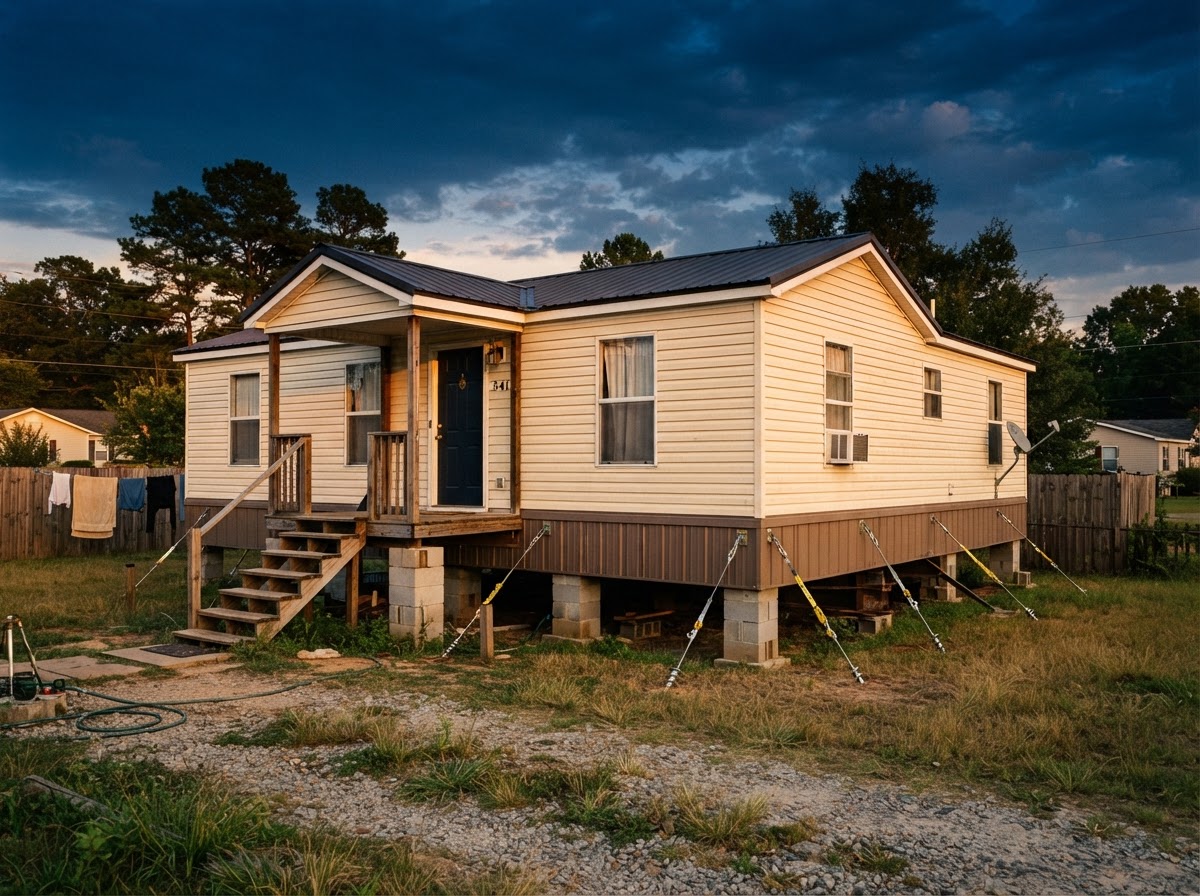
Mobile Home Leveling Montgomery
Mobile home leveling addresses the alignment of a home's main frame and the supports beneath it. When supports shift, settle, or shift with soil movement, the symptoms often appear inside — as sticking doors, sloping floors, or new cracks. This page explains what leveling involves, how it differs from related work, and how to request an assessment of your particular home near Montgomery.
Signs Your Mobile Home May Need Leveling in Montgomery
The signs that prompt a leveling question are usually noticed inside the home first. Floors that slope toward a wall, bounce underfoot, or feel spongy in one area can signal that supports beneath the home have moved. Interior doors that start to stick, drag, or swing open on their own can reflect a frame that is no longer sitting level on its supports.
Other common concerns include cracks forming above door frames or at the corners of windows, visible separation along a multi-section marriage line, and changes in the home's lower structure — skirting that has shifted, piers that appear cracked or leaning, or tie-down straps that look loose or rusted. None of these symptoms alone confirms a leveling need, because the same sign can come from ordinary wear, moisture, or framing issues rather than the support system.
Floor concerns
Door & window alignment
Cracks & separation
Support movement
Moisture & drainage
Hardware condition
Symptoms are reviewed, not assumed
The Leveling Assessment Process Around Montgomery
A typical inquiry begins with what you can safely describe from inside and around the exterior of your home. You do not need to crawl underneath, move equipment, or enter an unstable area to submit a useful request. The information you share — home configuration, location, what you have noticed, and your timing — helps identify what kind of qualified assessment may be appropriate.
An assessment then reviews the observable conditions: the existing support system, the site and soil, drainage, the anchoring hardware, and the home's configuration. Findings may point to leveling, support repair, drainage work, anchoring, or a combination — and actual scope always depends on professional evaluation of the conditions present at your home, not on a fixed procedure.
1 · Initial inquiry
You describe the concern, the home's configuration, and the property location — safely, without entering a crawl space.2 · Home & property review
The request is reviewed to identify what information and what kind of qualified assessment may be appropriate for the situation.3 · Assessment considerations
Observable conditions are evaluated — supports, site, drainage, anchoring, and configuration — to determine whether leveling, supports, drainage, or another response fits.4 · Potential work & next steps
Findings are discussed so scope, access, applicable requirements, and availability can shape the next project conversation. No repair schedule is guaranteed in advance.
Mobile Home Leveling Questions Near Montgomery
Common questions about leveling — with answers that do not promise a result before conditions are evaluated.
Explore Related Leveling & Foundation Services
- Manufactured Home LevelingHUD-code classification and installation considerations
- Double-Wide LevelingTwo-section alignment and marriage-line concerns
- Single-Wide LevelingSingle-section support and alignment concerns
- Triple-Wide & Multi-Section LevelingLarger multi-section configurations
- Modular Home LevelingModular construction and foundation distinctions
- Contact & Assessment FormShare your home details and request an assessment
Describe What You're Seeing and Request a Leveling Assessment
If your floors slope, your doors have started sticking, or you have noticed changes beneath or around your home, describing the situation helps determine whether leveling or a related service is the right next step. Share your home's configuration and location and the concerns you are noticing.
Your request will be reviewed and you will be contacted about appropriate next steps — with no obligation to proceed and no guaranteed scheduling before conditions are evaluated.