Alabama Mobile Home Tie-Down Requirements Explained
A homeowner-focused guide to how Alabama regulates manufactured-home tie-downs and ground anchors, how wind zones and site conditions influence anchoring, and what to verify before requesting a professional assessment of an existing system.
What tie-down and anchoring requirements apply to manufactured homes in Alabama?
Alabama enforces manufactured-home anchoring through the Alabama Manufactured Housing Commission (AMHC) under Administrative Code Chapters 535-X-12 and 535-X-13, which incorporate HUD's Model Manufactured Home Installation Standards (24 CFR Part 3285). The exact number, type, angle, and placement of tie-downs are not universal; they are determined by the home's documented design wind zone, the manufacturer's DAPIA-approved installation manual, soil conditions, and the specific foundation system used. A licensed AMHC-certified installer must verify the approved design for the particular home and site before any anchoring work begins.
1. Why Tie-Down Requirements Matter in Alabama
Tie-downs and ground anchors are the components that resist wind-induced uplift, sliding, and overturning forces on a manufactured home. In Alabama, where severe thunderstorms and tornadoes are recurring seasonal hazards, properly engineered anchoring is a primary life-safety consideration, not merely a formality.
An effective anchoring system integrates several connected elements working together. No single strap or anchor makes a home structurally secure on its own; the system's performance depends on how each component matches the home's weight, the site's soil, and the design wind forces the home was built to resist.
Ground Anchors
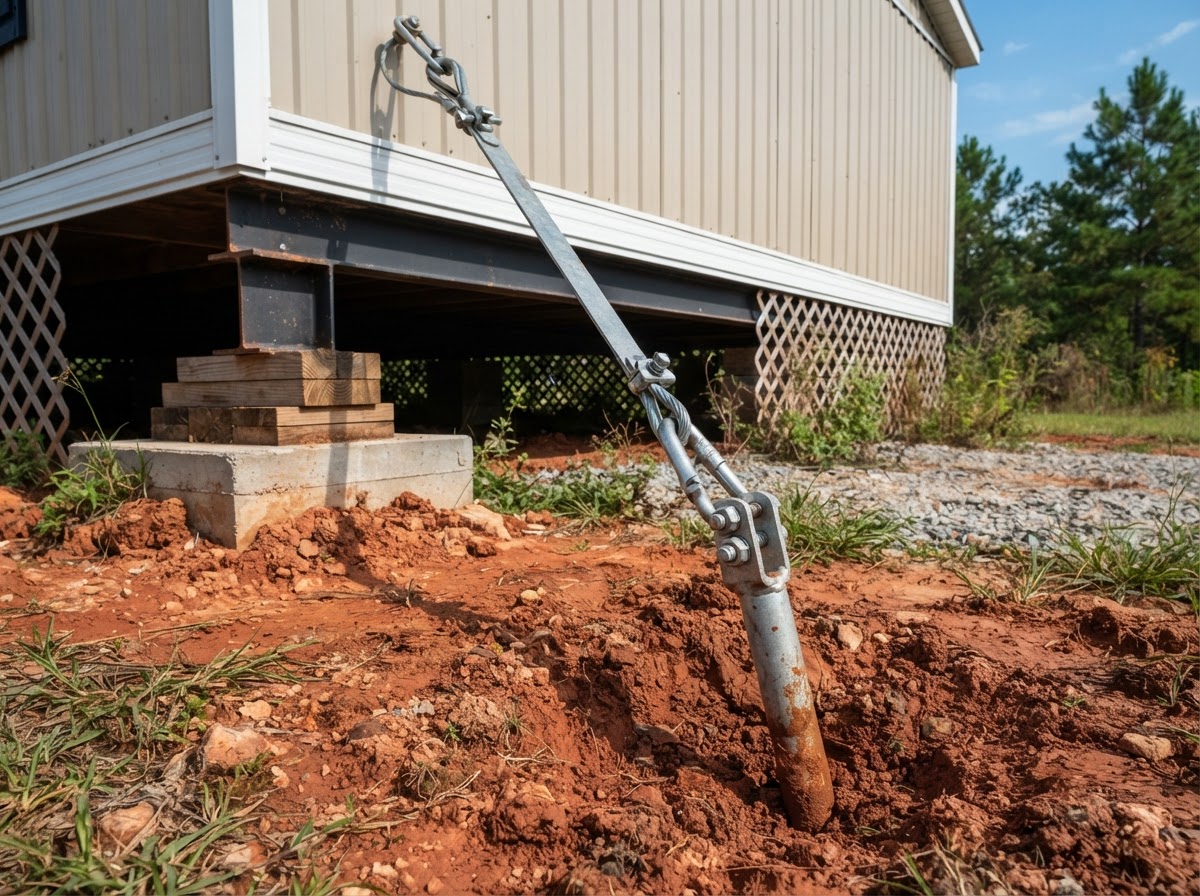
Steel anchors driven or augered into the soil that engage the ground to resist uplift and lateral forces. Their holding capacity depends on soil class, installation depth, angle, and whether a stabilizer plate is required.
Tie-Down Straps
Galvanized steel straps that connect the home's steel frame to the ground anchors. Straps must be tensioned, routed, and protected against corrosion and edge damage according to the approved design.
Frame Connections
The points where straps attach to the manufactured home's main steel I-beams. Connection hardware must be compatible with the frame and installed at the locations specified by the manufacturer.
Stabilizer Components
Plates, braces, and approved devices that resist lateral movement and keep anchors from slicing through soil under wind loading. Stabilizer plates are commonly required for diagonal anchors.
2. Alabama Manufactured Housing Requirements
The Alabama Manufactured Housing Commission (AMHC) is the state agency that administers manufactured-home installation standards. Under AMHC Administrative Code Chapters 535-X-12 (installer certification) and 535-X-13 (anchoring and setup standards), the Commission incorporates and supplements HUD's Model Manufactured Home Installation Standards (24 CFR Part 3285) for work performed in Alabama.
These rules establish that installation, anchoring, blocking, and leveling of a manufactured home must be performed by an AMHC-certified installer, follow the manufacturer's DAPIA-approved installation manual where available, and be documented with an AMHC installation decal linking the home, parcel, and installer in the state database.
A common misconception is that any repair performed on an existing home triggers the identical approval pathway as a brand-new installation. Routine corrective re-leveling of a settled home generally focuses on adjusting existing piers and shims. However, when anchoring systems are replaced, footings reconstructed, or the home is relocated, the work must satisfy applicable state installation standards and may require new inspection and decal documentation.
3. How Wind Zones Affect Anchoring
HUD classifies manufactured homes by design wind zone under 24 CFR 3280.305. A home's data plate identifies the wind zone for which it was designed. Alabama spans multiple wind-zone exposures; interior counties such as Montgomery, Autauga, and Elmore fall within Zone I, while coastal areas such as Mobile and Baldwin counties fall within Zone II.
The documented design wind zone, recorded on the home's data plate, directly influences the number and placement of tie-downs the manufacturer's installation manual requires. A home designed for Zone I may not be suitable for installation in a higher Zone II location without an engineered foundation design.
Wind-zone designation does not guarantee that a home will withstand every severe storm. It identifies the design conditions the home was built to resist. Actual performance depends on the home's condition, the anchoring system's integrity, the site's exposure, and the severity of the weather event.
4. Signs That Tie-Down Components May Need Attention
Several observable conditions can indicate that an existing anchoring system warrants professional evaluation. These signs are observations, not diagnoses; a qualified installer must determine the actual condition and appropriate response.
Visual symptoms alone do not prove the entire system's condition. Many critical components are buried in the soil or concealed beneath skirting, and their true state can only be confirmed through appropriate inspection.
- Visible corrosion, flaking, or rust scaling on exposed straps or connection hardware
- Straps that appear slack, kinked, twisted, or routed at incorrect angles
- Loose, displaced, or missing connection hardware at the frame attachment points
- Deteriorated or exposed anchor heads, or soil that has visibly eroded away from an anchor
- Disturbed soil or signs of movement around the anchor locations
- Storm-related displacement of skirting, piers, or the home itself
- Missing or bent stabilizer plates on diagonal anchor installations
5. What Happens During a Professional Anchoring Evaluation
A professional anchoring evaluation assesses the existing system against the requirements appropriate for the specific home and site. The scope is informational and diagnostic; it is not a substitute for the certified installation work that may be required afterward.
An evaluation typically addresses the home's identification and classification, the existing anchor layout, the visible condition of straps and hardware, the manufacturer's installation requirements, site and soil conditions, the foundation support system, applicable standards, and documentation needs.
- Home identification, data plate, and HUD certification label review
- Existing anchor layout, spacing, and angle verification
- Visible condition of straps, connections, and stabilizer components
- Manufacturer installation instructions and approved anchoring design
- Site conditions, soil class, and drainage review
- Foundation support configuration and its relationship to the anchoring system
- Applicable AMHC, HUD, and local requirements
- Recommended next steps and documentation
6. Alabama Tie-Down Verification Checklist
Use this checklist to organize the information needed before requesting an anchoring assessment or authorizing repair work. Gathering this information in advance helps a qualified professional evaluate the system efficiently.
Alabama Tie-Down Verification Checklist
- 1Identify the home's age and classificationDetermine whether the structure is a HUD-code manufactured home, a pre-1976 mobile home, or another building type, as this determines which anchoring standards apply.
- 2Locate manufacturer documentationFind the data plate, HUD certification label, and the manufacturer's installation manual, which specify the approved anchoring design for the home.
- 3Verify the design wind zoneConfirm the wind zone recorded on the data plate and compare it to the intended installation location using current HUD guidance.
- 4Check the existing system's visible conditionFrom a safe position, note visible corrosion, loose hardware, slack straps, or disturbed soil around anchor locations.
- 5Confirm applicable state requirementsReview current AMHC rules under Chapters 535-X-12 and 535-X-13 through amhc.alabama.gov for the specific scope of work.
- 6Determine whether an inspection is appropriateIf visible symptoms, recent storms, or a property transaction raise questions, request a professional anchoring evaluation before authorizing repairs.
- 7Obtain a written professional assessmentRequest a written evaluation that identifies deficiencies, references the approved design, and recommends appropriate corrective work.
- 8Keep repair and inspection recordsRetain all documentation, including AMHC decals, installer credentials, inspection reports, and repair invoices, for financing and resale purposes.
Verify current rules directly with the responsible federal, state, and local agencies:
- Alabama Manufactured Housing Commission (AMHC)
State agency administering manufactured-home installation, installer certification, and anchoring standards under Alabama Code Title 24, Chapter 5, and Administrative Code Chapters 535-X-12 and 535-X-13.
- HUD Model Manufactured Home Installation Standards (24 CFR Part 3285)
Federal installation standards incorporated by Alabama, specifying anchoring, blocking, and wind-resistance requirements for manufactured homes.
- HUD Manufactured Home Wind Zones (24 CFR 3280.305)
Federal construction standard defining Wind Zones I, II, and III and the data-plate documentation used to verify a home's design rating.
Regulatory Notice: This guide provides general educational information. Requirements can change and may vary by property location and project scope. Confirm current rules with the applicable government agency and qualified professionals before beginning work. Last verified: November 2026. Research verified November 2026.
Frequently Asked Questions
Related Alabama Foundation & Setup Services
Explore related services and educational guides for manufactured-home foundation care across Montgomery and Central Alabama:
Concerned About the Condition of Your Home's Tie-Down System?
Request a Leveling Assessment to describe visible symptoms, review existing anchoring conditions, and determine whether a qualified anchoring evaluation is the appropriate next step.
Inquiries are coordinated for residential and commercial manufactured homes across Montgomery, Autauga, and Elmore counties.